
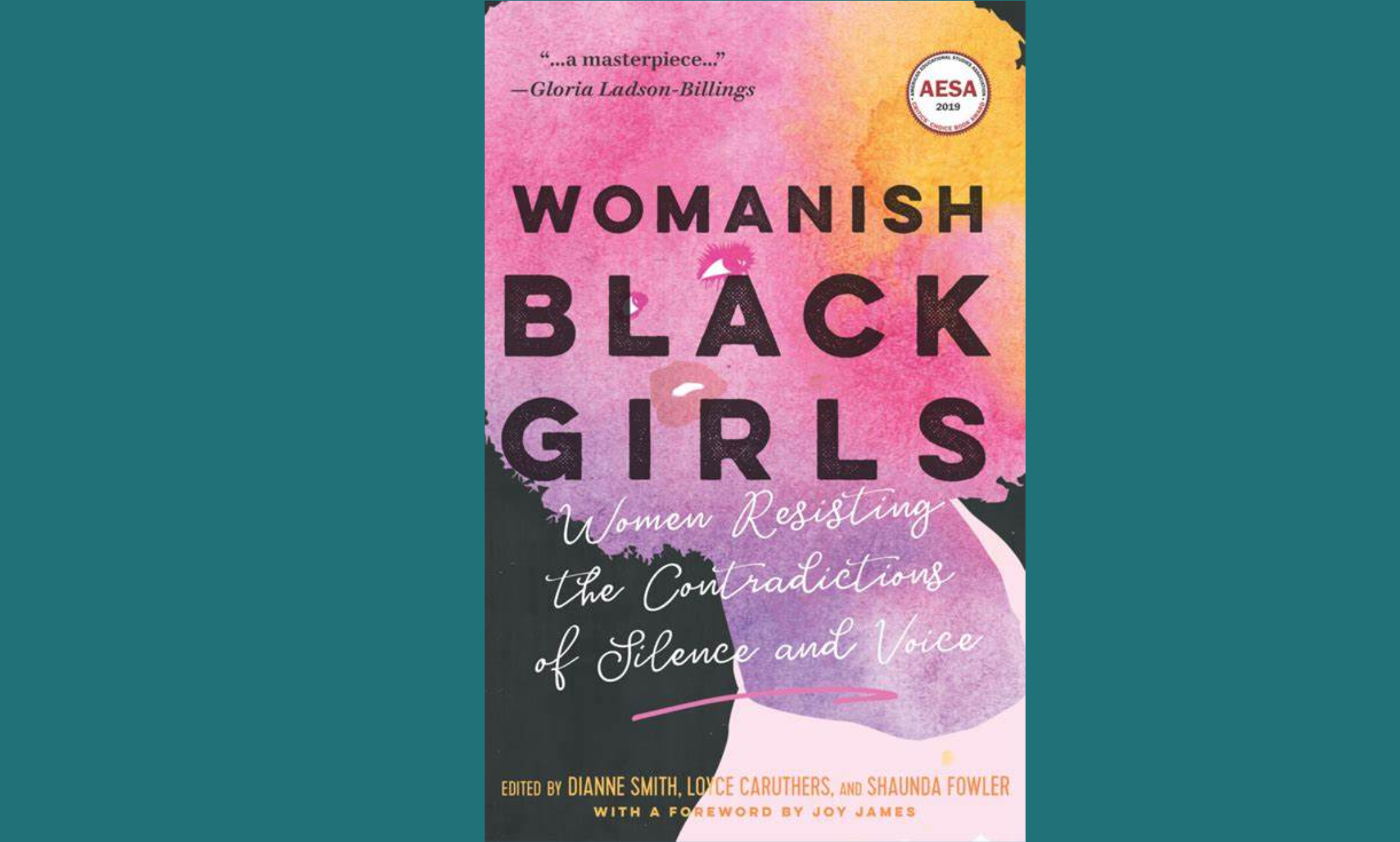
Education Faculty Publish Award-Winning Collection of Essays

Womanish Black Girls/Women Resisting Contradictions of Silence and Voice

“Womanish.” It’s an anthology of stories meant to break the silence and spark conversation surrounding key issues around power and transformation among Black women, and two School of Education faculty members – professor Loyce Caruthers, Ph.D. and professor emerita Dianne Smith, Ph.D. – are among the trio of editors who compiled this award-winning literature.

Since it was published in 2019, Womanish has received two awards and sold out twice.

  • Society of Professors of Education Outstanding Book Award, 2020
  • American Educational Studies Association Critic's Choice Book Award, 2019

While it can serve as a secondary text in academia, Caruthers and Smith said book clubs from Kansas City to North Carolina have read and discussed the collection of essays.

“We all have different interpretations about what womanish means, but one of the common themes was about speaking your mind and being heard." - Smith

“There is a lot of hope and self-empowerment in this book,” said Caruthers. “The themes in each of the stories shed light on things that have impacted all of our lives that we don’t always understand.”

The editors said the power of the book comes from breaking the silence about topics from abuse to religion to the stereotypes and sexualization of Black women and girls. Each of the writers pulls from personal and familial life experiences to share how their lives were shaped from childhood to adulthood.

“'Womanish' for me comes from the fact that we are sexualized too early as little girls. There was also Black male patriarchy where we were to be seen and not heard,”  Smith said. “I used to ask my Sunday School teacher why Eve was blamed for the fruit and not Adam, and I was shamed for that.”

The idea for “Womanish” stems from Smith’s dissertation and previous writings, which focus on themes surrounding race and racism, feminist theory, critical educational theory and curriculum theory. When the opportunity came to publish a book, she said knew she needed to include more than one Black woman’s voice, so she invited Caruthers and Shaunda Fowler, principal of Troost Elementary in Kansas City, to contribute and serve as co-editors.

“The themes in each of the stories shed light on things that have impacted all of our lives that we don’t always understand.” - Caruthers

Each woman has her own story to tell, they have each had various experiences growing up being called “womanish.”

“We all have different interpretations about what womanish means, but one of the common themes was about speaking your mind and being heard. A lot of it has to do with our mothers protecting us from cultural and social oppression,” said Smith, adding that the book, for some, is hard to read.

Caruthers said “Womanish” is about each author grappling with the secrets of their lives, things that they know happen to women but that become silenced and left unaddressed.

“Womanish” is a book for every generation of woman from every walk of life, says its writers. The list of authors includes women from academia and from the broader community. Voices from the past and present can be heard as, throughout the book, each writer chose different Black women authors and theorists to pull from as influence and inspiration: Audrey Lorde, Alice Walker, Brittany Cooper, Rebecca Walker and Maya Angelou and Joy James, who authored the foreward, are among the voices you can expect to be presented in this collection of work.

“If you don’t know where you’ve been,” said Caruthers, “you don’t know where you’re going.”

About The Book:

Womanish: Black Girls/Women Resisting Contradictions of Silence and Voice” is a collection of essays written by varied black women who fill spaces within the academy, public schools, civic organizations and religious institutions. These writings are critically reflective and illuminate autobiographical storied-lives. A major theme is the notion of womanish black girls/women resisting the familial and communal expectations of being seen, rather than heard. Consequently, these memories and lived stories name contradictions between “being told what to do or say” and “knowing and deciding for herself.” Additional themes include womanism and feminism, male patriarchy, violence, cultural norms, positionality, spirituality, representation, survival and schooling. While the aforementioned can revive painful images and feelings, the essays offer hope, joy, redemption and the re-imagining of new ways of being in individual and communal spaces. An expectation is that middle school black girls, high school black girls, college/university black girls and community black women will view this work as seedlings for understanding resistance, claiming voice and healing.

Dianne Smith

Dianne Smith is professor emerita in Educational Leadership, Policy, and Foundations at the University of Missouri-Kansas City School of Education. Her work focuses on race/racism, womanist/feminist theory, critical educational theory and curriculum theory. She has served as a visiting scholar at the University of Western Cape and Nelson Mandela University (formerly University of Port Elizabeth), both in South Africa. She is a past president of American Educational Studies Association.

Loyce Caruthers

Loyce Caruthers is a professor and past chair of Educational Leadership, Policy and Foundations at the University of Missouri-Kansas City, and has been with UMKC since 2001 where she teaches courses to prepare school administrators and qualitative research methods for doctoral students. Loyce also serves as the coordinator of the Ed.D Education Administration Program. Loyce’s research involves the use of voice through narrative and critical race theory for exploring phenomena related to race, class, gender and other differences that may influence educators’ beliefs and perceptions, and ultimately their work in schools. Recent publications include a co-authored book, Great Expectations: What Kids Want from Our Urban Public Schools. She is engaged in a collaborative project, Kansas City Speaks: Stories of School Desegregation, a website to share stories of school desegregation through oral histories, artifacts, archival documents and images made accessible to the public with a community yearbook feature and lesson plans for educators.

Shaunda Fowler

Shaunda Fowler was born and raised in Compton, California and spent a significant portion of her life with her maternal grandparents in the Imperial Courts Projects (PJs) in Watts. Growing up in the inner-city, she learned that being womanish was a way of survival. It is her hope that girls/women of color will be brave enough to have courageous conversations about being womanish in order to heal old wounds and find joy. Fowler was a middle-school principal in a small Midwestern school district where many of the girls of color can be considered womanish.


Top Stories